


More than 600 farmers and farming activists yesterday demonstrated outside the Executive Yuan in Taipei, calling for a halt to an irrigation project for the Central Taiwan Science Park’s (CTSP) Erlin campus.
The farmers, who came from Changhua County’s Sijhou (溪州), Pitou (埤頭), Jhutang (竹塘), Tianjhong (田中) and Beidou (北斗) townships, held aloft signs, banners, balloons and farm produce as they accused the government of trying to destroy farming, the major means of livelihood for the tens of thousands of households in the area.
To provide water for the use of the Erlin Campus, the Changhua County Irrigation Association has agreed to allow the science park to take a maximum of 33,000 tonnes of water per day — for NT$3 per tonne — from Cizaipijun (莿仔埤圳), the major irrigation channel for southern Changhua County.
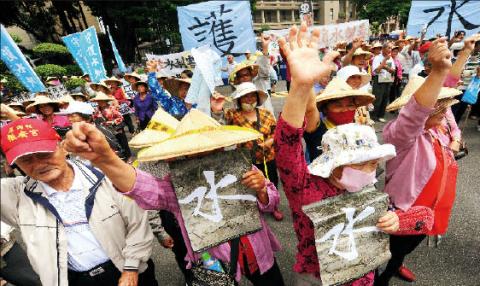
Photo: Lo Pei-der, Taipei Times
Area farmers fear the move would reduce the amount of water available to them for irrigation.
“We have already been hurting for water since the Jiji Dam (集集攔河堰) was built more than a decade ago — water only comes through Cizaipijun four days out of 10,” Hsieh Pao-yuan (謝寶元), a Sijhou farmer and the president of the Alliance against CTSP’s Seizure of Water, told the crowd.
“The irrigation channel supplies water for 18,000 hectares of farmland, which 30,000 households depend on,” Hsieh said.
“How are these families going to survive if farming has to be suspended due to lack of water? Can the science park provide enough job openings for all these people?” he asked.
The Jiji Dam on the Jhuoshuei River (濁水溪) deviates water from the upper stretch of the river and sends tens of thousands of tonnes of water to the Formosa Plastics oil refineries in Mailiao Township (麥寮), Yunlin County. This has limited the water available downstream for farmers to use.
Thomas Chan (詹順貴), a lawyer and long-time farming activist, said the irrigation project not only poses a serious threat to farming activities in southern Changhua County, but it is illegal — along with the construction work that began earlier this year.
Although the Environmental Protection Administration says the scale of the construction does not require an environmental impact assessment (EIA), this is not true, he said.
“The laws on EIAs stipulate that an EIA is required if a construction would take more than 2 cubic meters of water per second. However, according to the Changua County Irrigation Association’s own official figures, the CTSP would be taking 3.078 cubic meters of water per second from the irrigation system,” Chan said. “Moreover, an EIA is required when a construction site is larger than 10 hectares and a 13 hectare sand settling pond is planned for the project.”
The government should not turn a blind eye to the facts and should intervene immediately, Chan said.
Meanwhile, National Chengchi Unversity’s Department of Land Economics chairman Hsu Shih-jung (徐世榮) said the government was “shameful” and “makes farmers take to the streets for their own survival.”
“I don’t know whether it is worth celebrating for the Republic of China’s centennial, since this government is not treating the people right,” he said.
Executive Yuan official Liu Yi-chuan (劉益權), who came out to take the petition from the demonstrators, said the government would take the farmers’ opinions into consideration when making a decision on the project.
Minor scuffles broke out when Liu rushed back to the Executive Yuan, refusing to answer a question from farmers on whether the government plans to halt the construction now underway.
Protesters said they were not happy with the government’s response and vowed to take further action until the project is stopped.

UPGRADE: The Kang Ding-class frigate is replacing its Chaparall missiles with Tien Chien II and Hua Yang VLS, which would provide it with long-range, 360° air defense Taiwan plans to produce 1,200 to 1,376 Hai Chien II missiles (海劍二, Sea Sword II) — also known as TC-2N — to serve as the standard air defense system of the navy’s surface combatant fleet, a source said yesterday. Last week, the Hai Chien II, the naval version of the Tien Kung II missile (天劍二, Sky Sword II), completed a live-fire test in waters off the National Chungshan Institute of Science and Technology’s Jiupeng facility (九鵬) in Pingtung County’s Manjhou Township (滿州). The MIM72 Chaparral and other dated air defense missiles that currently arm Taiwanese ships have inadequate range to combat Chinese

REASONS FOR TRAVEL: An assistant professor said that proposed amendments to penalize drivers if they used drugs overseas would not deter people from traveling People who operate a motor vehicle under the influence of marijuana would have their driver’s license revoked, even if they used the substance while overseas, the Ministry of Transportation and Communications said yesterday, citing proposed amendments to the Road Traffic Management and Penalty Act (道路交通管理處罰條例). The amendments would also authorize the government to revoke the licenses of people determined to have used Category 1 or Category 2 narcotics, even if they were not operating a vehicle while under the influence of drugs, as well as ban them from taking the license test for three years, the ministry said. People aged 18 or

HEAVY WEATHER: Typhoon Jangmi is due to crash straight into the Ryukyus as airlines look to shift flights to larger aircraft or cancel flights to Okinawa entirely Taiwan’s international air carriers announced flight adjustments over the weekend as Typhoon Jangmi is forecast to hit the Ryukyu Islands today and tomorrow. The Central Weather Administration (CWA) upgraded Jangmi from a tropical storm to a typhoon at 8am yesterday, with the eye located 580km south of Naha city. It was moving north at 19kph. Today, China Airlines’ CI-120, CI-121, CI-122 and CI-123 flights between Taoyuan and Naha, Okinawa, have been canceled as well as CI-132 and CI-133 between Kaohsiung and Naha. EVA Air’s BR-112, BR-113, BR-186 and BR-185 flights between Taoyuan and Naha are also canceled. Low-cost carrier Tigerair Taiwan canceled IT-230,
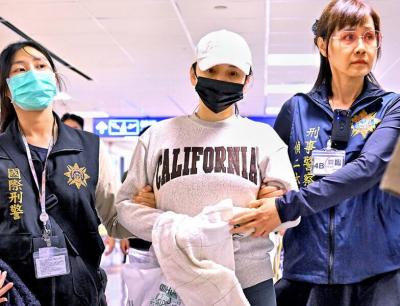
Johanne Liou (劉喬安), a Taiwanese woman who shot to unwanted fame during the Sunflower movement protests in 2014, returned to Taiwan last night after being deported from the US. She is to stand trial in Taiwan for charges involving embezzlement, fraud and drug crimes. The Criminal Investigation Bureau (CIB) said it took her into custody at Taiwan Taoyuan International Airport and would first question her before transferring her to the New Taipei District Prosecutors’ Office. She was arrested upon disembarking a flight from San Francisco that landed shortly before 7pm. Liou absconded to the US in 2019 after jumping bail


 RSS
RSS